
Pipeline, Fusion & Water Line Questions
Straight answers to the questions operators, landowners and builders ask us most.
Questions & Answers
What does a pipeline contractor do in the Bakken?
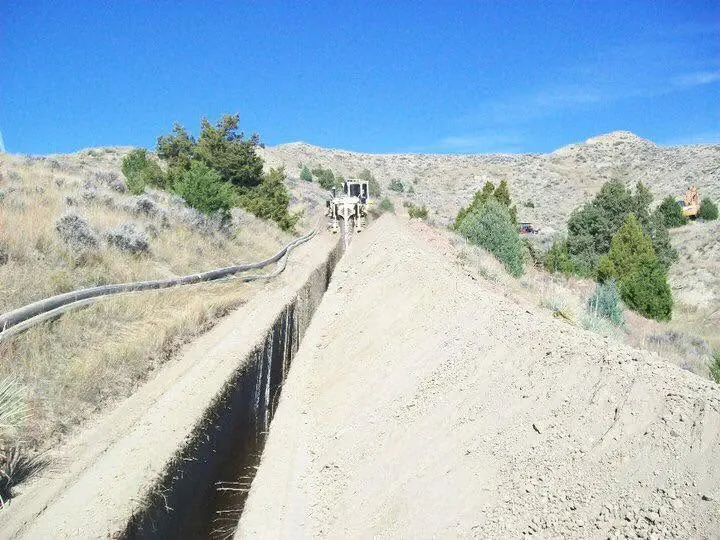
A pipeline contractor builds the lines that move gas, oil and water between wells, pads, compressor stations and disposal sites. That covers clearing the right-of-way, trenching, stringing pipe, fusing or welding joints, tie-ins, pressure testing, backfill and reclamation. Eaton Construction does all of it with its own crews, fusion equipment and trucks.
What is HDPE butt fusion, and how strong is a fused joint?
Butt fusion heats the squared ends of two polyethylene pipes to a set temperature, then presses them together under controlled pressure until they cool into one continuous piece. A properly made butt-fusion joint is as strong as the pipe itself and does not leak, which is why HDPE is the standard for gas gathering and water transfer lines.
What size poly pipe can you fuse?
All sizes. We fuse all of our own mainline poly pipe with a McElroy MFT 20 Fast Fusion machine, and every employee is trained and certified in poly-pipe fusion. Tell us the diameter, SDR and footage of your line and we will confirm the setup, crew and schedule.
How deep do water lines need to be buried in the Dakotas?
Deep enough to stay below frost. In western North Dakota, water lines are commonly buried 7 to 8 feet; in western South Dakota, 5 to 6 feet is typical. Your engineer, rural water system or county sets the exact spec, and we build to it.
Do I need to call 811 before digging in North Dakota or South Dakota?
Yes. Both states require a locate request at least 48 hours before you dig, not counting weekends and holidays — North Dakota One Call and South Dakota 811 both take requests by phone at 811 or online. On our jobs, we place the locates and verify marks before any equipment breaks ground.
What is the difference between a flowline and a gathering line?
A flowline carries production from a single wellhead to nearby equipment such as a separator, treater or tank battery on the pad. A gathering line collects gas, oil or water from many wells and pads and moves it to a central facility, compressor station or transmission line. We build both.
Steel, fiberglass or HDPE — which pipe is best for oilfield lines?
It depends on pressure, temperature and what the line carries. HDPE is corrosion-proof, flexible and fast to fuse, so it suits low-pressure gas gathering and water transfer. Fiberglass handles corrosive produced fluids at higher pressures. Steel is used for higher pressure and temperature. We install all three to the operator's spec.
Do you install rural water or stock water lines for ranches in western South Dakota?
Yes. From our St. Onge base we install poly water lines, service connections and stock water lines for ranches, landowners and rural water systems in Butte, Lawrence and Meade counties. The same fusion equipment and crews that build our oilfield lines build yours.
What areas do you serve?
Western North Dakota — Watford City, Williston, Alexander, Arnegard, Keene, Killdeer and the rest of McKenzie, Williams and Dunn counties — from our Watford City shop. Western South Dakota — Belle Fourche, St. Onge, Spearfish, Sturgis, Whitewood and Newell — from our St. Onge office. Ask about projects outside those areas.
What do you need from me to put together a bid?
The location (legal description or GPS is ideal), the footage, the pipe material, diameter and pressure rating, any drawings or specs, crossings such as roads or other lines, and your target start date. Send what you have; we will ask for the rest.
Who will actually be on my job site?
Our owner. Wayne Eaton is on the job site every day for quality control, and our crews are cross-trained across fusion, equipment and trucking. All employees are fusion-certified, and new employees don't fuse unsupervised for sixty days, even after certification.
What is hydrovac potholing, and when do I need it?
Hydrovac potholing uses pressurized water and a vacuum truck to dig small, precise holes that expose buried pipelines and utilities without damaging them. It's used to confirm the exact location and depth of a line before crossings, tie-ins, bores or trenching near live lines. We run our own hydrovac truck.
Can you bore under roads and existing lines?
Yes. Bores are part of both our poly and steel pipeline work. We bore under roads, driveways and other obstacles so the line crosses without an open cut, and we pothole existing lines with our hydrovac truck first to confirm where they are.
Are your crews safety trained?
Yes. All Eaton Construction employees are MSHA trained and OSHA certified. We hold daily tailgate safety meetings and do daily equipment inspections, and both are documented. Hard hats, steel-toe boots and safety glasses are required, and most of our employees have been with us for five years or more.
Do you haul your own pipe, equipment and materials?
Yes. Eaton Construction is a registered interstate motor carrier (USDOT 1441252, MC-544645) and runs its own trucks for pipe, oilfield equipment, construction materials and gravel, so jobs are not waiting on outside haulers.
Have a Line to Lay or Ground to Move?
Send us the scope: footage, pipe size and location. An owner will call you back.